Eight-Handled Sword Divergent Sila Divine General Mahoraga
Eight-Handled Sword Divergent Sila Divine General Mahoraga is the strongest and most terrifying shikigami in Jujutsu Kaisen—an entity so uncontrollable that no Ten Shadows Technique user in Zenin family history ever managed to tame it.
Commonly known simply as Mahoraga, this Divine General is the “final trump card” of the Ten Shadows: a summon that trades the user’s life for a chance at mutual destruction. With its towering, deity-like form, eight-handled dharma wheel, and overwhelming adaptation ability that can counter even Satoru Gojo’s Infinity, Mahoraga JJK stands at the crossroads of myth, religion, and pure combat horror.
This guide breaks down everything about Mahoraga its origins, summoning ritual, powers, battles, weaknesses, and story impact—so you can fully understand why this shikigami is treated less like a weapon and more like an unavoidable calamity.
Description
Identity, Titles & Classification
Eight-Handled Sword Divergent Sila Divine General Mahoraga (八握剣異戒神将魔虚羅, Yatsuka-no-Tsurugi Ikaishinshō Makora) is the most powerful and uncontrollable shikigami in Jujutsu Kaisen. Usually called simply Mahoraga (魔虚羅), it is the pinnacle of the Ten Shadows Technique, the hereditary Zenin clan cursed technique. Classified as an offense-focused Divine General, it combines overwhelming destructive power with an adaptation ability so extreme that no Ten Shadows user in history has ever succeeded in taming it.
Its full title is loaded with symbolism. “Eight-Handled Sword” references Yatsuka-no-Tsurugi, one of Japan’s legendary divine swords, while “Divergent Sila” draws from the Buddhist term śīla (戒), meaning moral discipline. The “divergent” aspect implies a being that exists outside normal spiritual or ethical boundaries. Among Ten Shadows shikigami, Mahoraga is the absolute last-resort trump card—a summon so dangerous it functions as a suicidal gamble against otherwise unbeatable opponents.
Appearance & Visual Characteristics
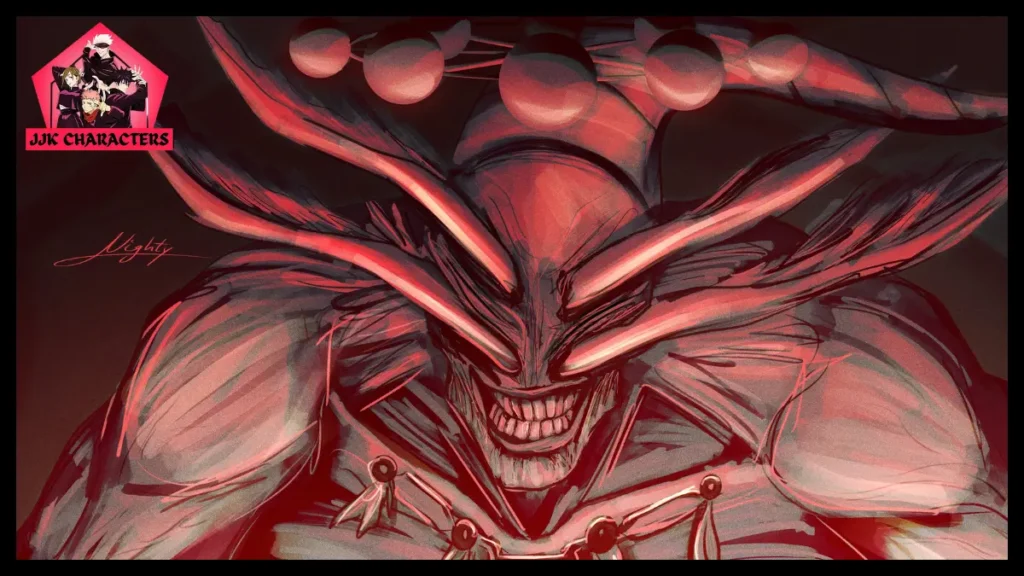
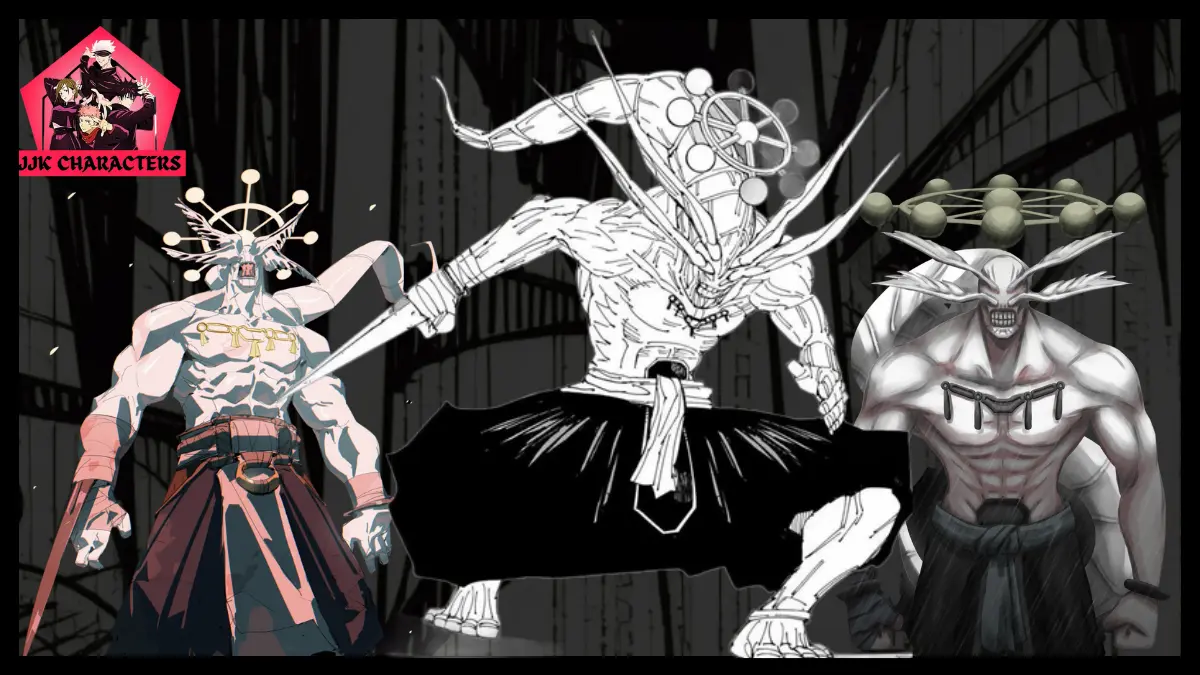
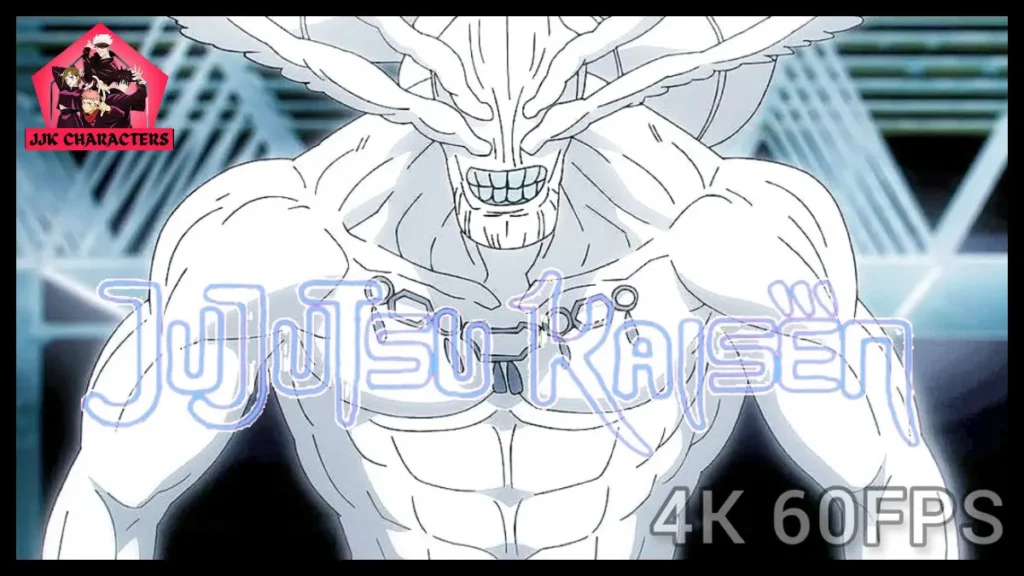
Mahoraga JJK appears as a towering, muscular humanoid that dwarfs most sorcerers, its very size radiating dread. Four wings emerge directly from its eye sockets, giving its face a grotesque, inhuman divinity, while a tail-like appendage extends from the back of its head with a serpentine motion reminiscent of the mythic Yamata-no-Orochi.
Above its head floats the eight-handled dharma wheel (法陣, hōjin), the Mahoraga wheel, which both symbolises perfect cycles and visually tracks its adaptation process with each rotation. Dressed in black hakama bottoms and a white sash, Mahoraga’s design fuses Buddhist divine general imagery with brutal physical menace—a walking paradox of protector deity and apocalyptic executioner.
Mahoraga JJK First Appearance (Anime & Manga)
Mahoraga JJK first entered the narrative partially during Chapter 9 of the manga, where its existence was hinted at through dialogue about the Ten Shadows Technique’s ultimate shikigami. However, its full, devastating debut occurred in Chapter 117, during the chaos of the Shibuya Incident. In the anime adaptation, viewers received a partial introduction in Episode 5, followed by a brief cameo in Episode 40, before the creature’s complete appearance shocked audiences in Episode 41.
That moment—Megumi summoning Mahoraga against Haruta Shigemo—became iconic within the fandom. The desperation in Megumi’s decision, coupled with the immediate, catastrophic power Mahoraga displayed, fundamentally shifted how viewers understood the stakes in Jujutsu Kaisen. It wasn’t simply a powerful summon; it was a declaration that certain battles demand sacrifices no sorcerer should be willing to make.
Origins and Role in the Ten Shadows Technique
What Makes Mahoraga the Ultimate Shikigami
The Ten Shadows Technique lets its user summon up to ten shikigami, but Mahoraga stands above them all as the ultimate—and fundamentally untameable—Divine General. Throughout the entire history of the Zenin Clan, no Ten Shadows user has ever successfully subjugated it.
Mahoraga’s core ability is adaptation to any and all phenomena (適応, tekiō). Rather than just learning patterns or building simple resistance, it analyses the very nature of whatever it faces—cursed techniques, physical attacks, or space-warping abilities—and evolves complete countermeasures.
Its eight-handled wheel is both the engine and symbol of this process, rotating as Mahoraga JJK advances toward full adaptation. In battle against Satoru Gojo, this allowed it to eventually bypass Limitless and Infinity, slicing through what should be untouchable space.
On top of this, Mahoraga wields the Sword of Extermination, a forearm-mounted blade that can switch between cursed and positive energy, making it especially deadly against cursed spirits.
Lore Connection to the Zenin Clan
The Zenin Clan’s history with Mahoraga is one of failure and fear. As one of the Three Great Sorcerer Families, they produced many Ten Shadows users, yet every attempt to tame Mahoraga JJK ended in the user’s death. Over time, the shikigami stopped being “just another technique” and became a symbol of the Ten Shadows’ double-edged nature—immense potential sealed behind near-certain suicide.
Megumi Fushiguro, though raised outside the Zenin household, inherited the Ten Shadows Technique and thus access to Mahoraga, an ironic contrast to his father Toji, who had no cursed energy at all. Unlike past users, Megumi understands that invoking Mahoraga’s subjugation ritual isn’t a strategy—it’s a binding vow: defeat the Divine General in one shot or die trying.
Usage
Megumi Fushiguro
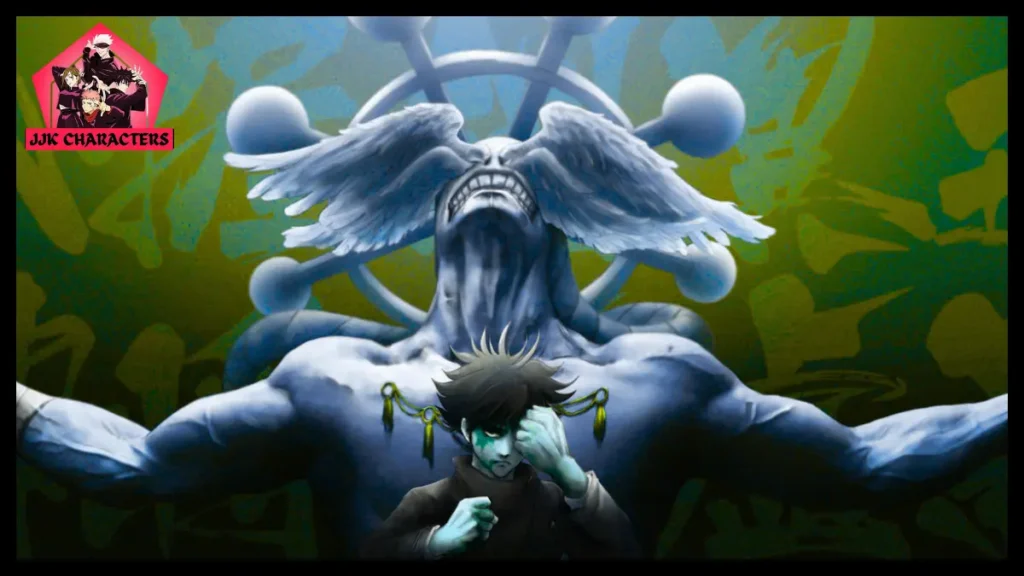
Mahoraga is Megumi Fushiguro’s absolute last resort—a do-or-die option used only when death feels unavoidable. Unlike his other shikigami, he can’t simply summon and command it; Mahoraga appears only via the subjugation ritual, a binding trial where the Ten Shadows user must defeat the Divine General to earn control. Once the incantation begins, Mahoraga JJK manifests and immediately tries to kill its summoner.
Historically, no Zen’in Ten Shadows sorcerer has survived this fight, which is why activating it is essentially a suicidal gambit. If Megumi dies first, Mahoraga then attacks anyone else within the ritual’s space. Crucially, even if another person manages to destroy it, they gain no control over the shikigami. Only the original summoner can claim mastery—and only by personally achieving victory.
Sukuna
Sukuna, the King of Curses, completely changed Mahoraga’s role in the story. After incarnating into Megumi’s body during the Culling Game, he gained access to the Ten Shadows Technique and attempted what no Zenin ever could: taming the Divine General.
Instead of fighting JJK Mahoraga in a straightforward subjugation duel, Sukuna exploited the technique’s mechanics by tying the eight-handled wheel and its adaptation burden to Megumi’s soul. This let Sukuna benefit from Mahoraga’s adaptive analysis without fully exposing himself to the ritual’s suicidal risk. During his battle with Yorozu and her True Sphere Domain, he used this setup to study and counter her technique, turning the “taming” into a prolonged learning process.
As a result, Sukuna became the first Ten Shadows user to successfully tame Mahoraga. In the Shinjuku Showdown, he then deployed it as a calculated counter to Gojo’s Limitless and Infinity, using Mahoraga—and Merged Beast Agito—to dismantle even Gojo’s seemingly untouchable defence.
Summoning and the Subjugation Ritual
How the Ritual Works
Summoning Mahoraga JJK requires a specific gesture and sacred chant. Unlike other Ten Shadows shikigami, which use hand shadow puppets, the user extends both arms straight forward with fists closed—no animal shape—immediately signalling that this is no ordinary summon.
The incantation is Furube Yurayura (布瑠部由良由良), translated by VIZ as “With this treasure, I summon…”. It comes from the ancient Shinto purification prayer furu no koto (hifumi no haraekotoba), which counts from one to ten—“hi fu mi yo i mu nana ya kokonotari furube yurayurato furube”—while invoking a swaying, cleansing motion. “Furube yurayura” literally means “shake and sway,” echoing ritual movements used to call the divine.
Once the chant is finished, the user recites Mahoraga’s full title, Eight-Handled Sword Divergent Sila Divine General Mahoraga, activating the subjugation ritual as the shikigami rises from their shadow.
Conditions, Risks & Requirements for the User
Calling Mahoraga is essentially suicidal. The subjugation ritual has no safety net, no partial success, and no retreat—once activated, the fight continues until Mahoraga JJK is exorcised (something no past Ten Shadows user has achieved) or everyone involved dies.
Normally, the eight-handled wheel floats above Mahoraga, turning as it analyses and adapts to phenomena. Sukuna revealed a twisted variation: the wheel can be placed on the user’s soul—such as Megumi’s—offloading the adaptation burden while the summoner reaps the benefits. This means the soul endures the strain of endless analytical cycles, risking deep psychological or spiritual damage.
On top of that, Mahoraga JJK doesn’t distinguish between enemies and bystanders. Its rampages can level city blocks, as seen in Shibuya, making it a “mutual destruction” option reserved only for truly hopeless situations.
Mahoraga JJK’s Powers and Abilities
Core Ability — Adaptation Mechanism Explained
Mahoraga’s core ability is adaptation to any and all phenomena (適応, tekiō). This isn’t simple pattern recognition or gradual resistance—it operates on a conceptual level, analysing the nature of whatever it encounters and evolving full countermeasures.
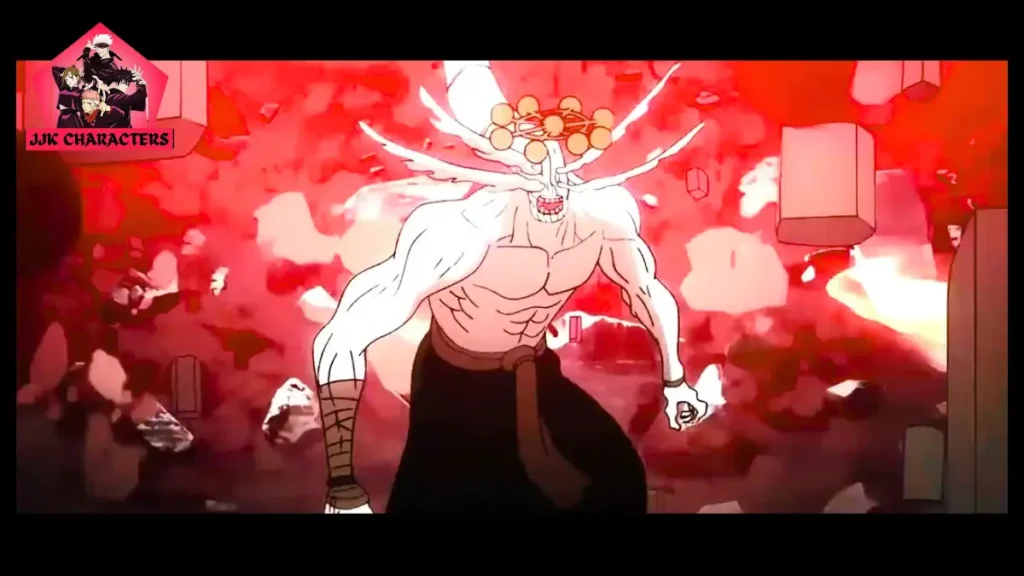
The eight-handled wheel acts as both processor and visual indicator. Each rotation marks progress in analysis, with simple attacks needing fewer spins and complex ones, like Gojo’s Infinity, requiring multiple rotations; Mahoraga JJK needed five full turns before completely bypassing Infinity’s “infinite space” defence.
Its adaptation appears in three main forms:
- Defensive – healing damage and eventually gaining outright immunity to that phenomenon.
- Auxiliary – gaining perception of normally invisible or intangible effects.
- Offensive – developing new attacks that directly exploit or bypass the adapted phenomenon, such as space-cutting slashes against Infinity.
Crucially, adaptation is phenomena-based, not tied to a single user’s technique, turning every fight into a race to defeat Mahoraga JJK before your entire toolkit becomes useless.
Physical & Combat Strength
Even without its adaptation, Mahoraga’s raw physical power ranks at the top of Jujutsu Kaisen. It can casually shatter concrete and launch opponents through buildings; in Shibuya, a single backhand nearly killed Megumi and dropped him into suspended animation, showing it doesn’t need named techniques to be lethal.
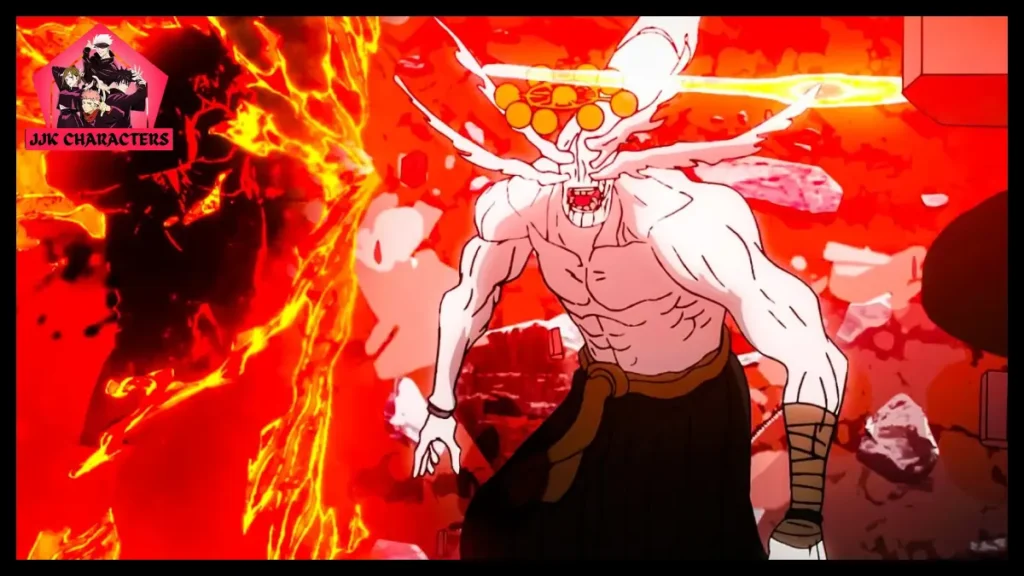
Mahoraga is also fast enough to briefly surprise Satoru Gojo, whose Six Eyes and combat experience make catching him off guard almost impossible. Its clash with Sukuna further proves its level: the King of Curses had to use Dismantle, Malevolent Shrine, and finally Divine Flame to put it down.
Most impressively, Mahoraga endured a Black Flash from Gojo and kept fighting—a strike that would instantly exorcise most curses. Any opponent trying to “outplay” its adaptation must first survive this overwhelming physical onslaught.
Sword of Extermination (Positive Energy)
The Sword of Extermination is a forearm-mounted blade that makes Mahoraga JJK especially deadly against cursed spirits. It can be coated in positive energy, which is the direct opposite of the negative cursed energy that forms curses. For humans, positive energy is tied to reverse cursed technique and healing, but for cursed spirits it acts like a lethal poison, unraveling their very existence.
Mahoraga can also switch the blade between positive and cursed energy depending on the target—using cursed energy for maximum damage against humans or curse users, and positive energy for rapid exorcism against spirits. This energy-switching pairs perfectly with its adaptation ability, letting Mahoraga JJK optimise both its defences and the fundamental nature of its attacks for each opponent.
Eight-Handled Wheel & Its Battle Impact
The eight-handled wheel (法陣, hōjin) floating above Mahoraga’s head isn’t just symbolic—it’s the core mechanism of its adaptation. Drawing on the Buddhist dharma wheel motif of cycles and harmony, here it represents continuous combat evolution. Each rotation marks concrete progress in analysing a phenomenon; simple attacks may take a single spin, while something as complex as Gojo’s Infinity required five full rotations before Mahoraga JJK gained space-cutting counters that bypassed “infinite distance.”
Because the wheel is visible, it adds psychological pressure: opponents can literally watch the countdown to their techniques becoming useless. Sukuna later showed the wheel can be bound to a soul—such as Megumi’s—offloading the adaptation burden and its spiritual strain while Sukuna reaps the benefits. Gojo briefly stalled the wheel using Amplification, turning it black, but only temporarily. Ultimately, the eight-handled wheel turns every clash with Mahoraga into a race against time that most enemies lose.
Durability, Regeneration & Defensive Capabilities
Mahoraga’s defence works on two levels: sheer endurance before adaptation, and near-immunity after it. While its wheel is still analyzing a phenomenon, Mahoraga JJK can tank catastrophic damage and regenerate from it, as seen when it endured Sukuna’s Dismantle slashes and Gojo’s Blue, surviving long enough to finish adapting.
Once adaptation is complete, its defence becomes conceptual immunity—techniques like Blue’s gravitational pull effectively stop interacting with it. Mahoraga even withstood Sukuna’s Malevolent Shrine for a time, an achievement that shows how high its defensive ceiling is.
However, there is a limit. Gojo’s Hollow Purple, which erases matter by combining Red and Blue, was able to completely disintegrate Mahoraga and its wheel in Shibuya. The only real strategy against it is clear: overwhelm Mahoraga JJK with massive, decisive attacks before its adaptation cycle fully completes.
Battles & Events
Notable Fights (Sukuna, Gojo Implications, Others)
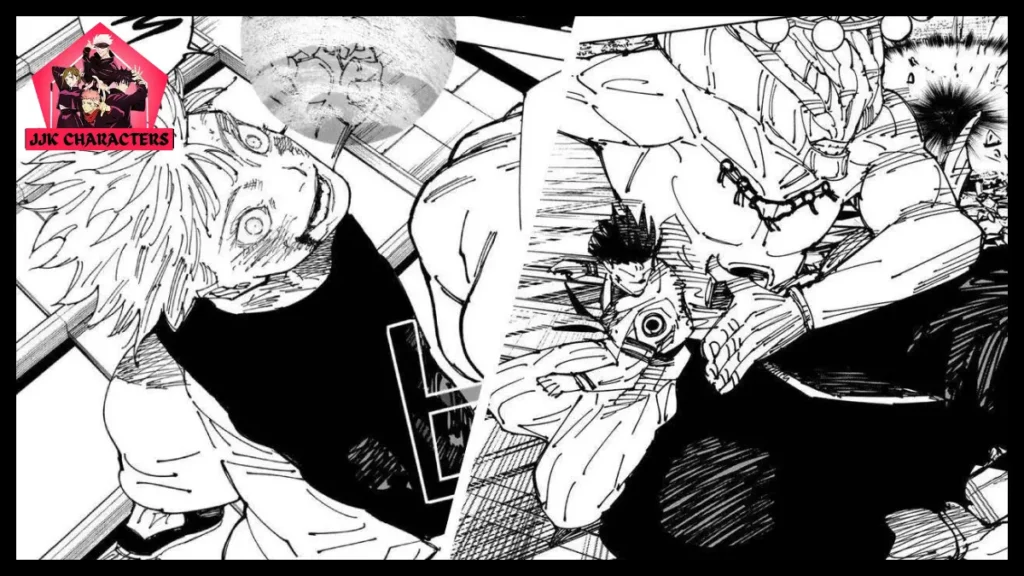
Sukuna vs. Mahoraga in the Shibuya Incident is Mahoraga’s first full showcase—a clash between the King of Curses and a Divine General that levelled city blocks. After Megumi’s desperate summoning, Sukuna engaged Mahoraga with Dismantle and then Malevolent Shrine, yet the shikigami’s regeneration and adaptation kept it in the fight until Sukuna finally erased it with Divine Flame.
In the Culling Game, Sukuna—now using Megumi’s body—treated Mahoraga JJK as a strategic tool rather than a direct summon. Against Yorozu’s Construction and True Sphere Domain, he placed the adaptation wheel on Megumi’s soul, using Mahoraga’s analysis to understand and counter her technique while progressing toward taming the Divine General.
The Shinjuku Showdown against Satoru Gojo is Mahoraga’s peak impact. Sukuna summoned it specifically to crack Limitless and Infinity. As the wheel completed multiple rotations, Mahoraga JJK adapted to Blue’s gravity, perceived Gojo’s spatial manipulation, and evolved space-cutting slashes that ignored distance itself, especially when combined with Merged Beast Agito’s pressure—turning the battle into a proof that even Gojo’s “invincibility” could be analysed and dismantled.
Major Story Arc Impact
In the Shibuya Incident, it shifts from clan folklore to active apocalyptic threat. Megumi’s desperate summoning becomes a defining moment, showing he’s willing to trade his own life if it means taking enemies down. The resulting destruction, plus Sukuna’s “solution,” establishes that Mahoraga-level combat naturally reduces city blocks to rubble. It also burdens Megumi with the knowledge that his trump card can level cities—but only at the cost of his own life.
In the Culling Game, Mahoraga changes from uncontrollable disaster to a tamed strategic asset in Sukuna’s hands. By exploiting the ritual and offloading adaptation onto Megumi’s soul, Sukuna overturns centuries of failure and shifts the power balance dramatically.
In the Shinjuku Showdown, Mahoraga becomes the key to cracking Gojo’s Limitless and Infinity, proving that even “perfect” defences can be analysed and undone—elevating Mahoraga to an existential threat for the entire jujutsu world.
Mahoraga JJK Weaknesses and Limitations
Despite its terrifying capabilities, Mahoraga isn’t invincible. The Divine General’s weaknesses centre on timing, overwhelming force, and strategic exploitation of the adaptation process itself.
Known Counters
Overwhelming Mahoraga before its adaptation completes is the most reliable counter. If an opponent can inflict enough damage before the eight-handled wheel finishes its rotation, Mahoraga JJK can be destroyed outright. Gojo’s Hollow Purple demonstrated this in Shibuya, completely erasing both the shikigami and its wheel before immunity could form.
Mahoraga’s regeneration and durability, while incredible, are not infinite during this phase. Extremely high-output attacks that outpace its healing—like those from Gojo or Sukuna—or tightly coordinated team assaults can theoretically break through before the wheel completes its cycle.
Another option is disrupting the adaptation itself. Gojo’s use of Amplification briefly caused the wheel to blacken and pause, suggesting that techniques which overload or interfere with cursed energy mechanics can buy crucial time.
In theory, bombarding Mahoraga with multiple complex phenomena at once could also strain its adaptation, but so far its battle record shows it handles multi-threat situations frighteningly well.
Situations Where Mahoraga Can Be Overwhelmed
Mahoraga is hardest to stop once its adaptation completes, so its rare vulnerabilities center on damage it can’t outheal or out-analyse in time. Area-of-effect annihilation that leaves no room for regeneration is especially dangerous. Techniques like Sukuna’s Malevolent Shrine, which blanket a wide area in continuous, guaranteed-hit slashes, can damage Mahoraga faster than it can heal if sustained long enough.
Hollow Purple represents the upper limit: it doesn’t just injure, it erases. Because Mahoraga must survive initial exposure to adapt, conceptual erasure that deletes its body and wheel outright prevents adaptation altogether.
In theory, coordinated attacks from multiple top-tier sorcerers using very different techniques could also overwhelm it before any single adaptation finishes, though its speed, strength, and battlefield chaos make such teamwork extremely hard.
A subtler weakness lies in how it adapts. As seen with Gojo’s Blue, certain adaptations can be exploited—once Mahoraga resists being pulled, its fixed position can be used against it by a creative, high-skill opponent.
Trivia
Mahoraga’s name and design are steeped in religious and mythological references. It draws heavily from Makora Taishō (摩虎羅大将), one of the Twelve Divine Generals (十二神将, Jūni Shinshō) who serve Yakushi Nyorai, the Buddha of Medicine. In Sanskrit, this figure is called Mahāla.
The term “Mahoraga” itself comes from the Sanskrit महोरग, referring to half-human, half-serpentine beings found in Hinduism, Jainism, and Buddhism, part of the dharma-protecting Eight Legions (Aṣṭasenā). This serpentine link echoes in Mahoraga’s tail-like appendage and imagery similar to Yamata-no-Orochi, the eight-headed, eight-tailed dragon of Japanese myth.
Official English media introduced a naming twist: the proper Japanese reading is Makora (魔虚羅), but VIZ chose “Mahoraga,” aligning with the Sanskrit term. Crunchyroll originally used “Makora” before switching to match VIZ, standardising a technically inaccurate name.
Its full title also carries meaning: “Divergent Sila” (異戒) references śīla, Buddhist moral discipline, implying a being outside normal ethics, while “Yatsuka-no-Tsurugi” (八握剣) nods to a legendary divine sword. The summoning chant “Furube Yurayura” comes from the Shinto furu no koto purification prayer, and the dharma wheel above its head symbolises cycles and harmony—here twisted into perfect combat adaptation, like Gege Akutami’s “late throw in mushi-ken,” where you cheat by always countering after seeing your opponent’s move.
References
The primary canon sources for Mahoraga’s lore, abilities, and battles include:
Jujutsu Kaisen Manga Chapters: 9 (partial mention), 117 (full debut), 118, 119 (Shibuya Incident battle with Sukuna), 217, 219 (Culling Game / Yorozu battle context), 229, 230, 231, 232, 233, 234, 235, 236 (Shinjuku Showdown / Gojo vs Sukuna battle).
Jujutsu Kaisen Anime Episodes: 5 (partial mention), 40 (cameo), 41 (full appearance and Shibuya battle), with subsequent episodes covering the Culling Game and Shinjuku Showdown arcs adapting the manga’s Mahoraga content.
Official English Localizations: VIZ Media (manga) and Crunchyroll (anime) provide the primary English-language access to these chapters and episodes, though with noted translation differences regarding the name Mahoraga vs. Makora.
Frequently Asked Questions
What does Megumi say to summon Mahoraga?
He extends both fists forward and chants “Furube Yurayura,” then says the full title “Eight-Handled Sword Divergent Sila Divine General Mahoraga.”
How to summon Mahoraga?
You must be a Ten Shadows Technique user, extend both arms with closed fists, chant “Furube Yurayura,” then speak Mahoraga’s full title to trigger the subjugation ritual.
How tall is Mahoraga?
Its exact height isn’t stated in canon, but visual scaling suggests roughly 3–4 meters (about 10–13 feet) tall.
How to draw Mahoraga?
Draw a towering muscular humanoid with an eight-handled wheel above its head, wings from its eye sockets, a head-tail, black hakama, and a forearm sword.
How did Sukuna beat Mahoraga?
In Shibuya, Sukuna wore Mahoraga down with Dismantle and Malevolent Shrine, then completely destroyed it using his fire-based technique Divine Flame.
What episode does Sukuna fight Mahoraga?
Sukuna’s full fight with Mahoraga is shown in Jujutsu Kaisen anime Episode 41 (during the Shibuya Incident arc).
Did Mahoraga die?
Mahoraga was exorcised by Sukuna in Shibuya, but as a Ten Shadows shikigami it can be summoned again once tamed through the ritual.
When does Mahoraga spawn in AUT?
In A Universal Time (AUT), Mahoraga appears as a boss/event spawn with timers and conditions that change between updates, so players must check current patch info.
Conclusion
Eight-Handled Sword Divergent Sila Divine General Mahoraga is Jujutsu Kaisen’s ultimate paradox—a divine protector turned apocalyptic weapon, built around perfect adaptation and near-inevitable destruction. Rooted in Buddhist and mythological imagery yet expressed through modern cursed combat, it marks the terrifying upper limit of what a technique like Ten Shadows can produce when power breaks past normal constraints.
For Megumi Fushiguro, Mahoraga JJK is an inherited curse as much as a weapon: a last-resort trump card that almost guarantees his own death. For Sukuna, it becomes a coveted prize and surgical counter tool, letting him tear down even the strongest defences. And for Satoru Gojo, Mahoraga stands as proof that not even Infinity is absolute—any “perfect” technique can be observed, analysed, and ultimately undone by an entity built to adapt beyond reason.